Set up the first train
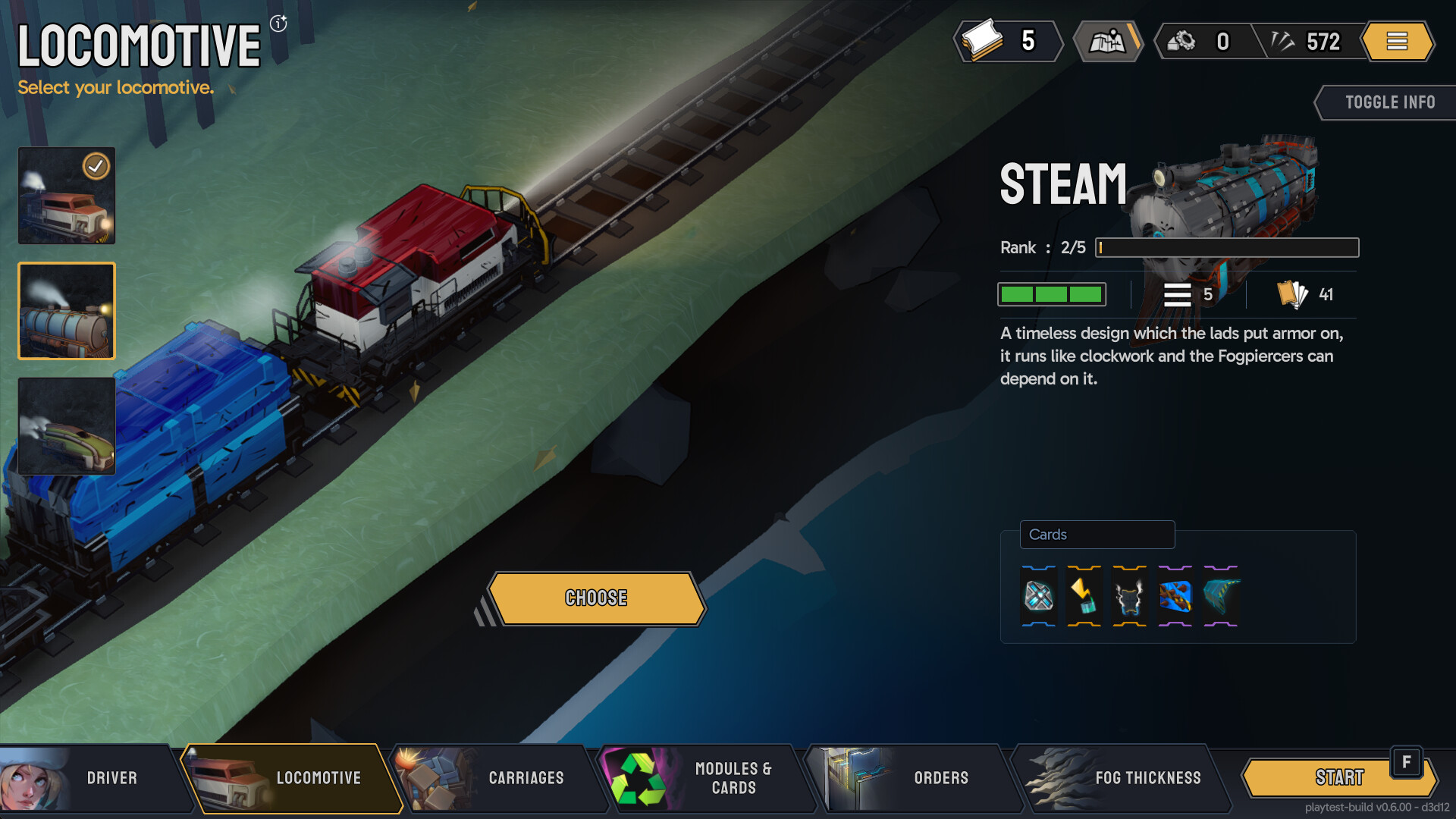
A run starts with choices for the driver, locomotive, carriages, modules, cards, and Fog Thickness. Those choices are not cosmetic: they create the opening deck and decide which tiles your weapons can reach.
For a learning run, favor a train whose cards have obvious jobs. The official beginner material recommends a Shield carriage behind the locomotive, creating a durable center while you learn attack ranges and movement costs.
- Read the complete starting deck before selecting a region.
- Keep fragile support cars away from exposed positions.
- Start at a Fog Thickness where mistakes remain recoverable.
Choose nodes for the problem you have
Fight nodes provide the basic battle loop. Convoys can award modules. Central Stations handle buying, selling, carriage upgrades, cargo, and rewards. Cash Shops offer cards, modules, and upgrades, while Random Encounters trade certainty for opportunity.
A route is better when it fixes a current weakness. If the deck lacks a useful interaction, a module reward may matter more than another ordinary fight. If the train is damaged or the deck is bloated, a station can be more valuable than a risky branch.
Use Scrap and Spikes for different horizons
Scrap changes the current run through purchases, deck changes, and carriage upgrades. Spikes improve future attempts by unlocking drivers, locomotives, carriages, modules, and cards between runs.
Do not judge a new carriage after one weak attempt. Its stronger card pool can require upgrades and another carriage before its intended synergy becomes visible.